Content Market Fit: Your Secret Weapon For Pipeline Generation
Here's how to get the right people to see you, recognize themselves in what you say, and turn it into conversations and pipeline.
Introduction
It's 2026 and most founders know they should post to grow an audience. If you didn't… it's okay (not).
Here's the thing.
Yes, consistency matters.
And also… consistency alone can still get you nowhere if you're missing the bigger piece: content market fit.
You can post on LinkedIn 7 times a week and still get:
- Likes from the wrong audience.
- Comments that don't turn into conversations.
- Zero inbound.
And honestly, it's kind of insane how often this gets missed because it's not complicated.
LinkedIn has over a billion users. Early on, the algorithm is basically throwing your posts into random rooms to see who reacts. If your content is about a different topic every time, it never learns who you're for. And can you blame it?
You end up "consistent"… but not relevant to your buyer.
What content market fit actually is
Content market fit is when your content reliably attracts the same type of person you want as a customer. Not once. Repeatedly.
It's when the right people keep seeing you, keep recognizing themselves in what you say, and eventually it turns into conversations and pipeline.
You know you're getting close when the signals stop looking random.
The part most people get wrong
Most founders treat content like a personality feed.
- Monday: fundraising thoughts.
- Tuesday: AI hot take.
- Wednesday: product update.
- Thursday: gym quote.
- Friday: a meme.
That's not strategy. That's just variety.
And variety is exactly what makes it harder for the algorithm (and your audience) to understand what bucket you belong in.
Early on, you want to be obvious.
- Obvious about who you help.
- Obvious about what you talk about.
- Obvious about why someone should follow you.
That's how you get content market fit.
Two examples that make this click immediately (and why they work)
The point isn't one viral post. It's a pipeline that compounds.
When you show up consistently with the same topics for the same people, the algorithm learns who to show you to. Your audience learns what to expect. Trust builds. And eventually, posting turns into conversations and pipeline.
Here are two real examples where you can see content market fit in the wild.
Example 1: Alex Hormozi (Acquisition.com)

Alex Hormozi is the co-founder and managing partner of Acquisition.com, and he's one of the most recognizable business creators on the internet. If you've been on LinkedIn for more than five minutes, you've probably seen his style already: direct, punchy, and obsessed with business fundamentals.
Hormozi doesn't write essays. He writes punches. Short posts. Clear lines. Lots of numbers.
He repeats the same core topics (leads, offers, sales, pricing, discipline, compounding) in different packaging over and over.
And that's the point. It's "I'm going to say the same valuable truth 100 different ways until the market learns to associate me with it."
Because he's not guessing what to talk about. He's dialed in on exactly what his audience wants: growth frameworks that feel immediately usable.
And his consistency isn't just "posting every day." It's consistent topic selection plus consistent voice plus consistent value density.
He's built an instantly recognizable style. He's also proof you don't need long posts to build authority. Clarity wins.
Example 2: Marty Kausas (Usepylon.com)
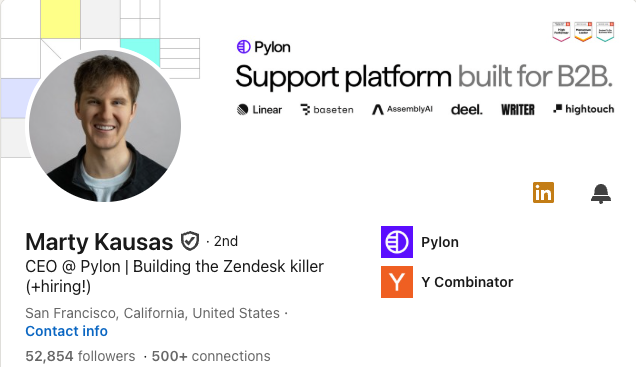
Marty Kausas is the CEO and co-founder of Pylon, a YC company.
I've personally been following Marty since he had under 10,000 followers, and I can tell you exactly what he posts:
- His company.
- Lessons from the journey.
- Decisions, tradeoffs, wins, mistakes.
Over and over. In a good way.
It's because his ICP is obvious.
If your audience is other startups (founders, operators, early employees), then posting about the startup journey is literally the most aligned content you can make. It's not random. It's not "content." It's the world his buyers live in.
But here's the real outcome: I know more people that know who Marty Kausas is than his company Pylon.
If you think of a modern startup founder building in public, he's one of the first names that comes to mind. I would argue his personal brand has become more valuable than his company brand.
So the algorithm learns who to show it to. And the people who see it instantly know: this is for me.
The fastest path to content market fit
Here's what actually works: pick your ICP. Pick 3 to 5 things your ICP cares about. Then spend the next 6 weeks posting mostly about those things.
That's it. That's the system.
Not because you're trying to be boring. Because you're trying to train the algorithm—and your audience—to understand what you're about.
And once they understand? That's when you get inbound. That's when everything changes.
Pick 3 to 5 content pillars (and stick to them)
A content pillar is just a category you return to over and over. It's the stuff you could talk about for hours without running out of angles.
For us at Dreamstate, that's things like:
- Why B2B content fails and how founders can fix it.
- Building in public (our journey to $30K MRR).
- How content actually generates pipeline and meetings.
- Real customer stories ("$5M in deals from one post" style).
Notice what's missing? We're not posting random life updates. We're not sharing gym motivation. We're being obvious about who we serve and what we're here to help with.
The boring truth is this: 80% of your posts should live inside these pillars. The other 20%? That's your experiment budget. We'll get to that.
This isn't a limitation. It's focus. And focus is what builds authority.
The thing founders get wrong about repetition
Most creators avoid saying the same thing twice because they think it looks like they've run out of ideas.
That's backwards.
Repetition is literally how you train both the algorithm and your audience. The creators you follow most? Ask yourself how many totally different things they talk about. It's not many.
And think about it from the algorithm's perspective: if you post about fundraising on Monday, AI funding on Tuesday, sales on Wednesday, and burnout on Thursday, the algorithm has no idea who to show you to. Your reach gets split across 10 different audiences instead of concentrated with one.
But if you post the same core insights in 20 different ways over 6 weeks? The algorithm learns. Your audience knows what to expect. Trust compounds.
You're not being repetitive. You're being efficient. And the best creators—Hormozi included—do this constantly.
Keep 20% for experimentation
So yes, stick to your pillars 80% of the time. But that remaining 20%? That's your permission to try new things.
This is how you stay fresh without confusing your audience. Stick with what works. But continuously test at the margins.
Watch what happens when you try a different format, a different topic angle, or a completely new approach. Sometimes it bombs. Sometimes you find the next winning formula that becomes part of your playbook.
MrBeast does this. He keeps the core concept (high-stakes challenges) consistent. But he experiments with new challenge types, new formats, and new collaborations. And when something works, he doubles down.
That's exactly what we're doing right now with this blog post. It's our 20%. Testing if we can write longer-form content that actually resonates with our audience.
Comment your way to visibility (the underrated tactic)
Here's what most founders don't realize: your own posts might never reach 10,000 people. But if you comment on a post with 100,000 views, your comment has access to all of them.
That's not a metaphor. That's how the algorithm actually works.
A thoughtful comment on a top creator's post will often outperform your own original post. The reach you get is their reach.
Most founders see commenting as a side activity. It's not. It's one of the highest-ROI tactics for building credibility and getting visibility.
Here's the system: find 3 to 5 types of accounts to comment on regularly. These are:
Then—and this is important—don't spam "Great post!" Stop. That's noise. Instead, add real insight using one of three patterns:
- Your ICP (the actual people you want as customers).
- Key influencers they follow (people whose opinion matters to them).
- Your competitors (because their audience is already interested in what you do).
- Agree + add a specific example: "100%. We actually saw this exact pattern when…"
- Politely disagree + offer an alternative: "Interesting take. We've found the opposite when you…"
- Build on their idea: "This connects to [related concept], and the key is…"
Why commenting wins where posting struggles
You're thinking: "Why is commenting so much more powerful than my own posts?"
Because you're not just broadcasting into the void. You're joining an existing conversation where people are already paying attention.
When someone clicks on a top creator's post and sees your comment first, they're way more likely to click your profile. They see you as someone with expertise who's actively contributing to the conversation. That's credibility.
So build a watchlist of 50 to 100 accounts you want to engage with. Turn on notifications. And be ready to drop a thoughtful comment in the first hour of their post going live.
First-mover advantage is real here. The comments that get the most views are the early ones from people with credible profiles.
Your profile is your homepage (optimize it like one)
You post something great. It gets traction. People click your profile.
And then... what? If your profile doesn't convert, all that traffic is wasted.
Your LinkedIn profile is basically your homepage. It needs to answer three questions immediately:
- Who are you? (Not your title—your mission.)
- Who do you help? (Your ideal customer, clearly stated.)
- What do you want me to do? (Your CTA, crystal clear.)
For your headline: don't put your title. Put your value prop. "CEO at Dreamstate" is invisible. "Building AI content engines that drive $10M+ in pipeline for B2B founders" is memorable.
Your About section is a micro-pitch. It should take 15 seconds to read and make someone want to click your CTA.
And your Featured section? That's your hero section. Feature your best case study, your lead magnet, your demo booking link. Make it obvious what the next step is.
- Start with your buyer type: "We work with B2B founders who…"
- Be specific about their problem: "They're struggling to…"
- Show how you solve it: "We've built a system that…"
- Prove it works: "Across 50+ clients, we've generated $X in pipeline."
- End with a clear ask: "Ready to learn more? Book a 15-min demo."
Conclusion: Why Dreamstate
Founder-led content works. The strategies and tactics in this guide aren't theory. They're the exact playbook that's helped B2B companies generate millions in pipeline through authentic LinkedIn presence.
But executing this consistently? That's the challenge. Between building product, closing deals, managing teams, and running day-to-day operations, finding 10+ hours per week for content is nearly impossible. Most founders know they need to build on LinkedIn. They just can't find the time to do it right.
That's the problem Dreamstate was built to solve.
Dreamstate is a full-stack B2B content engine that handles the entire content pipeline, from deep research to revenue-generating posts. The platform provides deep persona research that captures your unique voice, stories, and perspective from existing content. It creates high-fidelity content that sounds authentically like you, not generic AI output.
If you want to build your founder-led content engine, sign up or book a demo to see how we can help you grow your brand at scale.
Key takeaways
- Content market fit is when your content reliably attracts the same type of person you want as a customer. Repeatedly.
- Be obvious about who you help, what you talk about, and why someone should follow you.
- Pick 3 to 5 content pillars and put 80% of posts inside them; use the other 20% to experiment.
- Repetition trains the algorithm and the audience; it's okay to repeat yourself.
- Comment on top accounts in your space. Your reach becomes their reach.
- Optimize your profile: headline = value proposition, About = micro-pitch + CTA, Featured = key links.